

Back to School Is Getting Expensive. Give Your Kids a Budget, Not Just a Card.

For many families, August means clothing, electronics, activities, transportation, food and dozens of other expenses. And increasingly, many of those purchases are made by the kids themselves using a parent-provided debit or credit card.
In This Article
- What families are spending this school year
- The much bigger cost of college
- Why giving kids a card isn't the same as giving them a budget
- How parents and kids can manage school-year spending together
Back-to-School Spending Is Approaching $900 Per Family
The National Retail Federation estimates that families with children in elementary through high school will spend an average of $863.86 on back-to-school purchases in 2026.
Across the country, that's expected to total a record $43.3 billion.
And it's not mostly pencils and notebooks. The average family's expected spending includes about $293 for electronics, $250 for clothing, $174 for shoes and $146 for school supplies.
The year-over-year increase from $858.07 in 2025 isn't huge, but families are clearly managing the pressure. Nearly half of K–12 shoppers say they're buying only what their children need to start school and will purchase additional items later.
In other words, families are already budgeting—whether they call it that or not.
For College Families, the Numbers Get Much Bigger
College students and their families expect to spend an average of $1,437.79 on back-to-college purchases in 2026, up from $1,325.85 last year.
But that's just getting ready for college.
College Board estimates the average annual 2025–26 student budget at approximately:
- $21,320 — public two-year college, in district
- $30,990 — public four-year college, in state
- $50,920 — public four-year college, out of state
- $65,470 — private nonprofit four-year college
Those totals include much more than tuition. Housing, food, books, transportation and everyday personal expenses are all part of what it actually costs to be a student.
Interestingly, after adjusting for inflation, average public four-year tuition and fees are about 7% lower than they were a decade ago.
That doesn't mean college feels inexpensive. It means the affordability challenge is broader than tuition.
Small purchases become part of the real cost of school.
The Parent-Supplied Card Has Changed the Equation
Many of us grew up with a pretty obvious spending limit: cash.
If you had $40, you could spend $40. You could physically see what was left.
Today, parents often do something much more convenient. We give our kids a debit card, credit card or access to an account and tell them:
"Use it for what you need."
We've done it ourselves.
There's nothing wrong with the card. For teenagers and especially kids away at college, it's incredibly useful.
The problem is that access to money and a budget are not the same thing.
A card answers:
Can I buy this?
A budget answers:
Should I buy this—and what will I have left afterward?
That's the financial skill we really want our kids to develop.
Give the Card a Budget
Our research into the shift toward digital money found that cash now represents only about 14% of consumer transactions. Today's kids increasingly experience money as numbers on a screen rather than something physically leaving their hands.
That makes the budget more important, not less.
Instead of simply giving a teenager or college student a card, attach realistic spending categories to it:
- ✓ Food and dining
- ✓ Gas and transportation
- ✓ Clothing
- ✓ Entertainment
- ✓ School supplies
- ✓ Personal spending
Now a student doesn't have to wonder what "don't spend too much" means.
Dining budget: $250
Spent: $183
Remaining: $67
Suddenly, the next purchase has context.
Your First Budget Will Probably Be Wrong
And that's okay.
A parent doesn't necessarily know what a realistic food budget is for a freshman living 400 miles away. An 18-year-old probably doesn't either.
Set a reasonable starting budget. Watch what actually happens. Then talk about it.
Maybe transportation needs another $40. Maybe dining out can come down $50. Maybe groceries cost considerably more than anyone expected.
Budgeting shouldn't be a test that kids pass or fail. It's a process the family gets better at together.
Let Kids See the Budget Too
This may be the most important part.
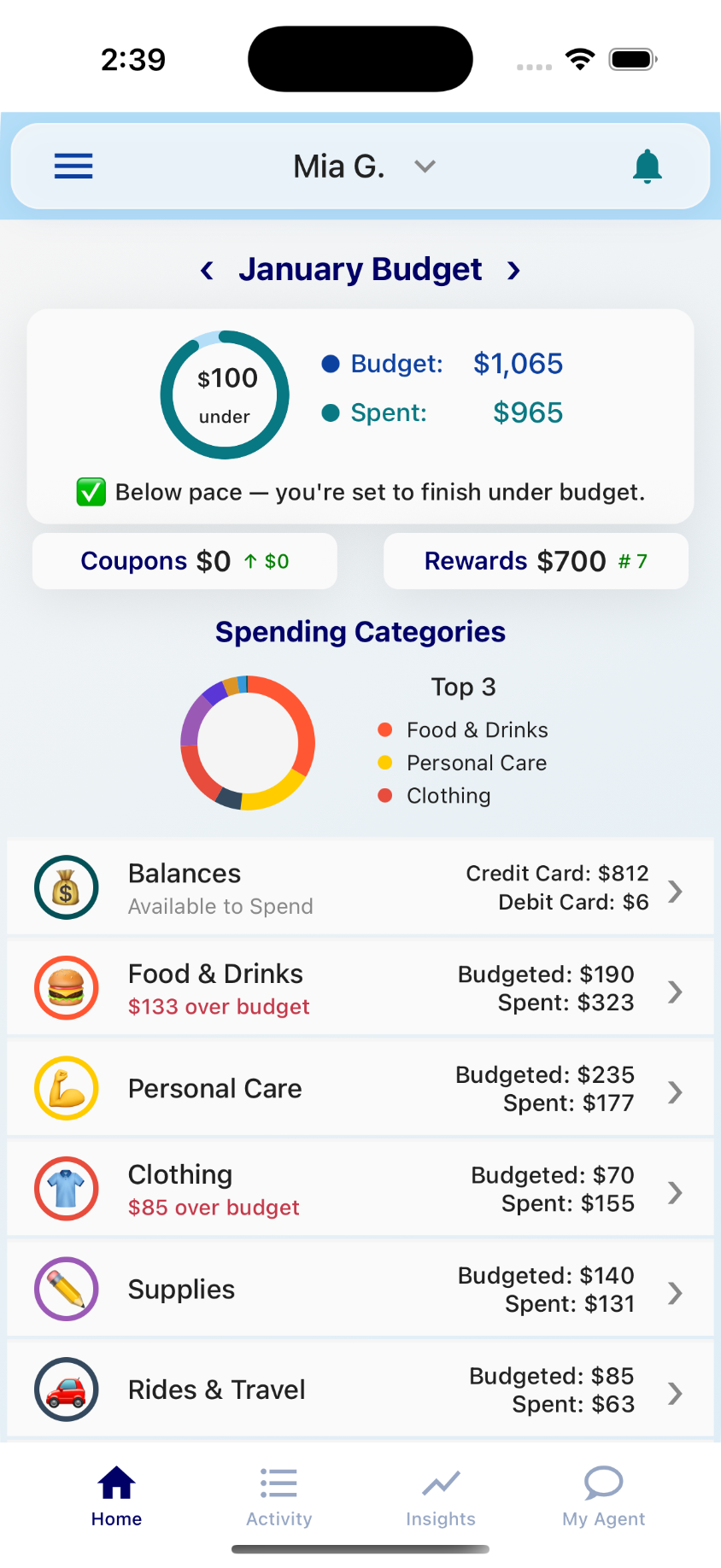
A teenager or college student should be able to look at their phone and immediately answer four questions:
- What do I have?
- What have I spent?
- Where did it go?
- How much do I have left?
That's very different from receiving a text from a parent saying, "You've spent too much this month."
One is financial feedback. The other can feel like monitoring.
FamFi was designed around shared visibility: parents can provide guidance while kids see their own balances, budgets and actual spending, building progressively greater independence as their money skills grow.
Back to School Is a Great Time to Start
Most people associate budgeting with January.
For families, August may actually be a better reset.
A new school year brings new schedules, activities, transportation needs and expenses. For a college student, it may bring an entirely new way of living.
Don't try to predict the entire year perfectly.
Create a reasonable budget for the first month. Then sit down together after 30 days and compare what you expected with what actually happened.
No lecture. No judgment.
Just:
Here's what actually happened.
What should we change?"
That's not just managing back-to-school affordability.
That's real financial education.
The budget teaches them how to decide."
Start the School Year With a Budget, Not Just a Card
FamFi connects real spending with budgets parents and kids can see together—so everyone knows what's been spent, what's left and when the budget needs adjusting.
Explore FamFi →
Grow Up Money-Smart.
From allowance to independence.
About the Author
Tom Giannulli, MD is the CEO and co-founder of FamFi. Inspired by the challenges of teaching his own children about money in a digital-first world, Tom helped create FamFi to give families practical tools that make budgeting, spending and financial conversations easier at every stage of growing up.
Continue Reading
7 Things to Do Before Setting Up FamFi
Prepare your family, financial accounts and first budget conversation.
Built for Real Families, Not Just One Age
How FamFi adapts from preteens through young adulthood.
The First Cashless Childhood
How digital payments are changing the way young people learn about money.


