

Why Families Download Safety Apps Before Finance Apps

The harder part is getting everyone to begin. Unlike a location or safety app, a family finance app asks people to look directly at spending, budgets, habits, and sometimes uncomfortable financial realities.
In This Article
- Why finance-app adoption can lag behind perceived value
- What App Store conversion data does—and does not—tell us
- Why families avoid uncomfortable financial information
- The supporter and implementer roles inside a family
- How families can make adoption easier
Useful After Adoption, Difficult Before It
Personal finance apps have an unusual challenge.
People often value them highly once they are set up, connected to real accounts, and providing useful information. Balances become easier to see. Spending patterns become clearer. Budgets become more practical. Families can make decisions using shared information instead of memory, assumptions, or scattered bank statements.
But the value comes after several steps:
- ✓ Downloading the app
- ✓ Creating a family account
- ✓ Connecting financial institutions
- ✓ Inviting family members
- ✓ Looking honestly at current spending
- ✓ Agreeing on budgets and expectations
That creates a gap between understanding that an app could help and actually putting it to work.
A family safety or location app offers a more immediate emotional benefit: reassurance. A finance app may offer just as much long-term value, but it can initially feel like work, exposure, or the beginning of a difficult conversation.
A finance app asks a family to prepare for tomorrow.”
What the Adoption Numbers Show
FamFi's App Store Connect reporting has shown a conversion rate of approximately 6% among App Store visitors. That means a relatively small share of people who reach the product page complete a first-time download.
Public benchmarks need to be interpreted carefully because app analytics companies do not always define conversion the same way.
AppTweak reported that, across U.S. App Store categories in 2025:
- ✓ The average page-view-to-download conversion rate was 8.56%
- ✓ The average impression-to-install rate was 3.8%
- ✓ Results varied substantially by app category
These numbers should not be treated as a direct comparison with every family or finance app. They do show, however, that reaching an App Store page does not guarantee a download—and that category, motivation, trust, and perceived effort all influence conversion.
Family location and safety platforms have achieved very broad adoption. Life360, for example, reported approximately 95.8 million monthly active users at the end of 2025. Its public reporting does not provide a directly comparable App Store page-conversion rate, but its scale demonstrates how readily families adopt technology tied to an immediate and easily understood need.
Finance-app adoption also depends greatly on what is counted as a finance app. Surveys may report high financial-app usage when they include mobile banking, payment, investing, and money-transfer apps. Dedicated budgeting and financial-management tools represent a much narrower behavior.
Checking a bank balance or sending a payment solves an immediate task. Building a family budget requires reflection, discussion, and ongoing behavior change.
Money Can Be Emotionally Uncomfortable
One reason people delay using financial-management tools is sometimes described as the ostrich effect: when people expect information to be unpleasant, they may avoid looking at it.
This does not necessarily mean they are careless. Avoidance can be a short-term way of reducing anxiety.
Opening a finance app may reveal:
- ✓ More spending than expected
- ✓ A budget that is not working
- ✓ Different priorities between partners
- ✓ A child's spending habits that need attention
- ✓ Financial decisions that have been postponed
Research on financial scarcity has found a relationship between financial pressure and increased financial avoidance over time. Unfortunately, avoidance can create additional costs because problems are discovered later rather than earlier.
The same pattern can affect conversations between parents and children. Parents may worry about burdening their kids, exposing their own mistakes, or starting a discussion they do not feel qualified to lead.
A recent study of parent-child financial conversations found that a parent's confidence with financial topics was the strongest predictor of whether those conversations occurred. Other research cited in the study found that parents who felt less capable with their own finances were more likely to shelter children from financial matters.
Knowing Money Matters Is Not the Same as Talking About It
There is a striking difference between what parents believe and what families regularly do.
Research summarized in the Journal of Family and Economic Issues found that 83% of parents with children under 18 agreed that parents are responsible for teaching personal finance. Yet 55% said they rarely or never talked about money with their children.
That gap is important for family finance apps.
Downloading the app may feel like more than installing software. It can feel like agreeing to begin a family conversation that has been postponed.
The good news is that the same research found that structured guidance helped parents start those conversations and increased the amount of time families spent discussing money.
Families do not need to begin with a perfect budget. They need a comfortable starting point.
The Supporter and the Implementer
Many family decisions involve at least two roles.
The supporter agrees that something would be good for the family. This person may encourage better budgeting, express concern about spending, or support teaching the kids stronger money habits.
The implementer turns that intention into action. This is the person who downloads the app, creates the account, connects the cards, invites the children, reviews the first budget, and remembers to return to it.
Sometimes the same person fills both roles. Often they do not.
The Supporter
- Believes the family should manage money more intentionally
- Encourages the idea
- Helps establish shared goals
- Reinforces the value with children
The Implementer
- Downloads and configures the app
- Connects financial accounts
- Invites family members
- Adjusts budgets and monitors progress
Adoption can stall when everyone supports the idea but no one clearly owns implementation.
Household financial responsibilities are also not distributed evenly. CFP Board research published in 2025 found that 69% of women surveyed described themselves as the primary household decision-maker for investment choices. Among married women, 60% said they were the main investment decision-maker.
This should not be used to assume that every household works the same way. It does suggest that app adoption strategies should recognize the person already carrying much of the family's financial or caregiving workload.
Asking that person to single-handedly introduce, configure, explain, and maintain another family system can create additional friction—even when the app will eventually make the job easier.
Kids Have a Role Too
Children and young adults should not be treated as passive recipients of a system created entirely by parents.
Research on childhood financial socialization has found that young adults who had childhood bank accounts and whose parents appropriately monitored spending were more likely to own financial assets and report more positive attitudes toward personal finance later.
The goal is not surveillance. It is guided participation.
Kids are more likely to engage when they understand what the app gives them:
- ✓ Their own view of balances and budgets
- ✓ Immediate knowledge of how much they have left
- ✓ A clear picture of where their money is going
- ✓ Progress toward goals or monthly rewards
- ✓ More independence as their skills grow
When the child sees a personal benefit, the app becomes a shared family tool rather than something being imposed by a parent.
How Families Can Make Adoption Easier
The best way to overcome adoption resistance is not to pressure everyone into a major financial overhaul.
Start with one useful experience.
- Choose an owner. Decide who will complete the initial setup.
- Give that person support. The other parent or caregiver should help gather account information and explain the plan to the kids.
- Explain the benefit to each child. Focus on what they will be able to see and manage themselves.
- Start with a suggested budget. Treat it as a first draft rather than a permanent rule.
- Schedule a short review. Revisit the budget after two or three weeks and adjust what does not fit.
- Avoid judgment. Use spending information to ask questions, not assign blame.
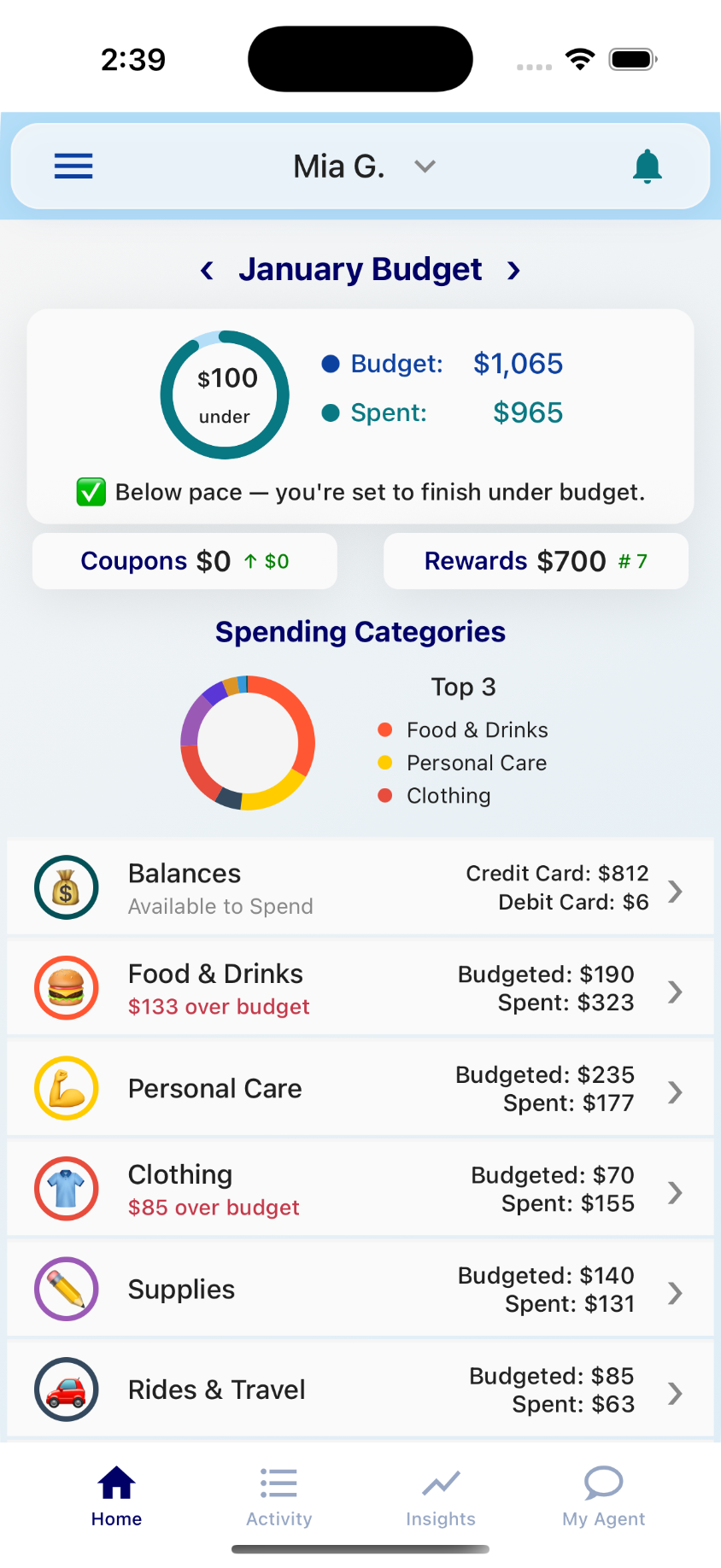
FamFi was designed around this process. Families can connect existing checking accounts and debit or credit cards, begin with AI-assisted budget recommendations, and then personalize categories as they learn what works. The FamFi app can onboard the family administrator and a child in 4 steps, which takes about 10 minutes. The process is easy and painless for most families and individuals that have their preferred banking information on hand.
The app provides structure, but the family still makes the decisions.
It only needs to begin the conversation.”
From Avoidance to Shared Visibility
The adoption challenge facing family finance apps is not simply a marketing problem.
It reflects how personal money can feel.
Safety apps address a worry families already discuss openly: “Where is everyone, and are they okay?”
Finance apps may bring forward questions families have been less comfortable asking:
- Where is our money going?
- Are our budgets realistic?
- What habits are our children developing?
- Who is responsible for helping the family improve?
Those questions can initially create resistance. But once a family has shared visibility, the app can replace uncertainty with information and turn occasional money lectures into practical, ongoing learning.
That is where the real value begins.
Make the First Step a Small One
Start with one family member, one connected account, and one realistic budget. FamFi helps your family build from there.
Explore FamFi →
Grow Up Money-Smart.
From allowance to independence.
Research and Sources
- AppTweak. “Average App Conversion Rate per Category, 2025.” View source
- Life360. “Life360 Reports Record Q4 2025 Results.” View source
- Alvarez Padilla, Y., Loibl, C., and Boone, B. “Money Talks: Testing a Series of Financial Literacy Modules to Encourage Financial Conversations in Middle School Families.” View source
- Hilbert, L.P. and colleagues. “Financial Scarcity and Financial Avoidance.” View source
- CFP Board. “Women Lead Financial Decision-Making in Most Households.” View source
- Kim, J. and Chatterjee, S. “Childhood Financial Socialization and Young Adults’ Financial Management.” View source
About the Author
Tom Giannulli, MD is the CEO and co-founder of FamFi. Inspired by the challenges of teaching his own children about money in a digital-first world, Tom helped create FamFi to give families practical tools that make budgeting, spending, and financial conversations easier at every stage of growing up.
Continue Reading
7 Things to Do Before Setting Up FamFi
Prepare your family, financial accounts, and first budget conversation.
Built for Real Families, Not Just One Age
See how FamFi adapts from preteens through young adulthood.
The First Cashless Childhood
Learn how invisible money is reshaping financial behavior.


